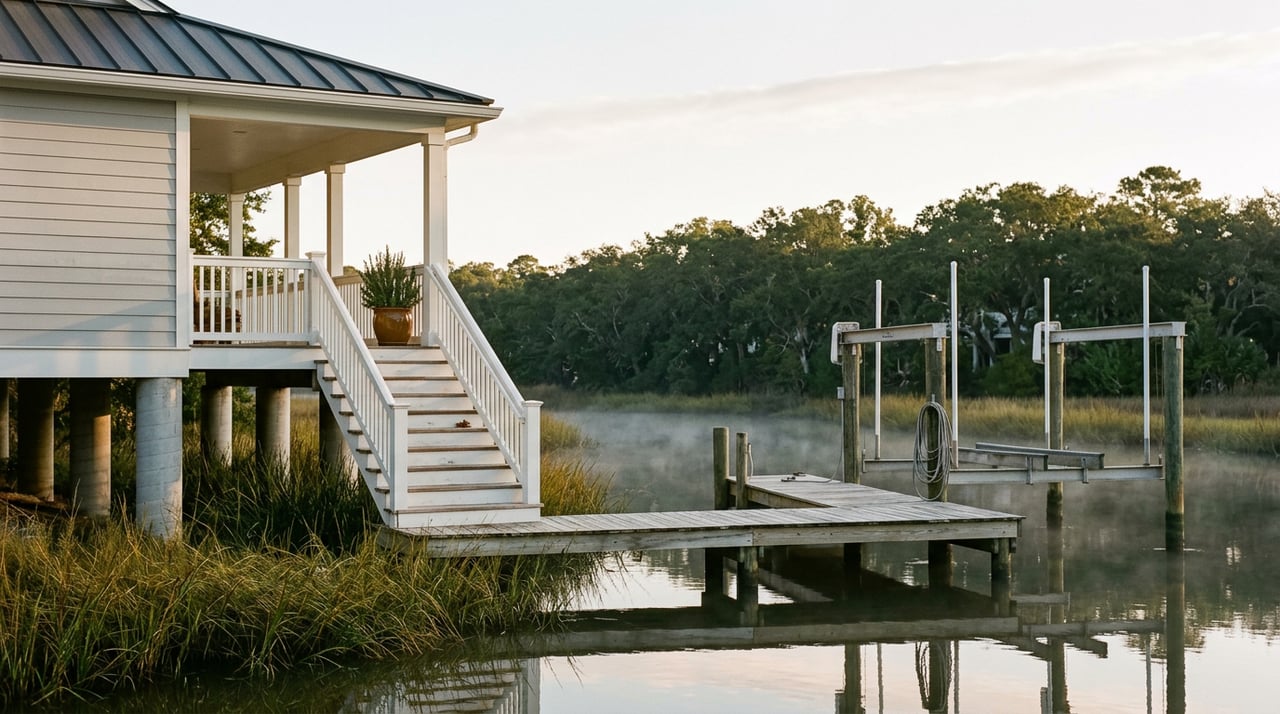
A few years back, Port City Daily reported that a south-end resident named Rick Crowder asked the Wrightsville Beach board of aldermen to lower the speed limit on Waynick Boulevard by 10 miles per hour. The issue was foot traffic. Homeowners on one side of the road park on the west side, then cross a 35 mile-per-hour, state-maintained street to reach the docks that belong to their houses, docks that sit on Banks Channel, across the road from the homes themselves. Port City Daily's account called the pattern the Waynick shuffle. The town couldn't act on the request because it doesn't control the speed limit on a state road, but the story stuck for a reason: it shows that on this island, owning water and touching water are not always the same transaction.
That distinction is the one buyers moving past the median-price headline need to understand. Wrightsville Beach real estate gets sorted into two categories on the portals: oceanfront and everything else. But the split that actually determines whether you can keep a boat at your house runs somewhere different. It runs between the open Atlantic side of the island and the protected channels behind it: Banks Channel, Motts Channel, and the Intracoastal Waterway. One side can hold a private dock. The other, in practice, cannot.
Two Kinds of Water on One Island
Every listing that mentions a private dock, a boat slip, or a lift sits on the channel side. A Banks Channel condo advertised with a boat slip right outside the door. An Intracoastal estate with a private dock and a 10,000-pound boat lift positioned for deep water access even at low tide. A Harbor Island cottage marketed for its walk-to-the-channel kayak and paddleboard access. Townhomes at Lees Cut built around boat slips rather than ocean views. None of these properties look east toward open water. They all look west, toward the calmer, tidal channels that separate the island from the mainland.
The reason isn't zoning preference. It's physics. A floating dock or a fixed boat slip needs water that doesn't move much: no breaking waves, no shifting sand, a bottom that holds a piling. The open Atlantic side of Wrightsville Beach doesn't offer that. So while a $10 million oceanfront home and a $1.2 million townhome at Lees Cut both get called waterfront, only the second one comes with a place to tie up a boat. If keeping a boat at the house is the point of buying here, "oceanfront" is the wrong filter. "Banks Channel," "Motts Channel," or "ICW frontage" is the right one. You can see the Wrightsville Beach neighborhood overview for how these pockets sit relative to each other on the island.
The Street Between the House and the Boat
The Waynick shuffle makes the point sharper than any listing sheet does. Along that stretch of the south end, the docks sit on a strip of sound-side land across Waynick Boulevard from the house itself. Crowder's complaint to the board, reported by Port City Daily, described more than 200 parking spaces on one side of Waynick and a long row of homeowner docks on the other, with pedestrians crossing constantly to reach their boats.
That arrangement is a reminder that water access on this island is a layered right, not a feature you can confirm from a photo. A buyer touring a home that backs up to a channel should ask whether the dock is deeded to that parcel, shared under an easement, or, as on Waynick, separated from the house by a road the town doesn't even control the speed limit on.
What the Permit Adds to the Timeline
Buying the right side of the island solves the physics problem. It doesn't solve the paperwork. Wrightsville Beach runs its own dock review on top of New Hanover County's coastal permitting, which is administered through the Wilmington field office of the state's Division of Coastal Management, according to a Wilmington-area dock builder that works the island regularly. Most lots on the island have less than 30 feet of frontage, which narrows how a dock can be laid out before it starts crowding a neighbor's riparian line.
Intracoastal Installs lists the following CAMA permit fees and processing times:
| Permit Type | Covers | Typical Fee | Processing Time |
|---|---|---|---|
| CAMA General Permit | Standard residential docks, piers, boat lifts, bulkhead repair | $100 to $400 | 14 to 30 days |
| CAMA Major Permit | Larger projects, marinas, or work in Areas of Environmental Concern | $400 to $475 or more | 75 to 150 days |
The town's own dock review runs alongside the state permit, something out-of-town buyers tend to miss when they're comparing a beach house to one three streets over on Banks Channel.
Insurance Runs on the Same Line
The same divide shows up again once you get past the dock and into the insurance quote. Oceanfront homes on Wrightsville Beach sit in FEMA's V or VE flood zones, where wave action during a storm is treated as a structural threat rather than simple water rise.
Wrightsville Beach is named specifically as one of the North Carolina coastal communities where V and VE zone designations are common, and coastal homes in those zones can run $3,000 to $5,000 or more annually in flood premiums, well above the $600 to $1,200 range typical of moderate-risk inland property. Channel-side homes generally sit in the less severe AE zone, where premiums track more closely to elevation above base flood level than to wave exposure.
North Carolina approved phased base-rate increases on homeowners insurance. A uniform percentage increase produces a much bigger dollar jump on a policy that started at $5,000 than on one that started at $1,200. The oceanfront premium and the channel-side premium were already different before this round of increases.
What the Current Listings Show
None of this happens in a market with much room to wait and compare. As of August 3, 2026, 42 homes were listed for sale on Wrightsville Beach through the local MLS, with a median list price of $1,975,000, an average of 91 days on market, and an average price of roughly $1,217 per square foot. That's a small pool for an island where oceanfront, Banks Channel, Motts Channel, and ICW frontage all get shown under the same "waterfront" label. There typically isn't a second listing down the street to compare against while you sort out whether a given dock is deeded, shared, or across a road you don't control.
A few things worth confirming before an offer goes in on anything described as waterfront:
- Whether the dock, if there is one, is deeded to the parcel or held under a separate easement
- Which flood zone the parcel sits in, not just the general area, since VE and AE boundaries can split a single block
- Whether a General Permit will cover the dock work planned, or whether it crosses into Major Permit territory
- What the current flood and homeowners premiums actually run on that specific structure, not a neighborhood average
A Few Straight Answers
Can an oceanfront lot get a private dock built anyway? In practice, no. Every dock, slip, and lift referenced in current listings on the island sits on a protected channel. The open ocean side doesn't offer the calm, stable water a floating structure needs, regardless of lot size or budget.
Does channel-side automatically mean cheaper insurance? Usually lower than VE-zone oceanfront, but the final number depends heavily on the home's elevation certificate and construction year, not just which side of the island it's on.
Is Banks Channel the only place to look for dock access? No. Motts Channel and Intracoastal Waterway frontage carry the same physical advantage. Banks Channel just shows up most often because it runs closest to the island's developed core.
The dock question is the kind of thing that's easy to overlook from a listing photo and expensive to discover after closing. If keeping a boat, managing flood exposure, or simply understanding what a specific Wrightsville Beach address actually gets you is part of the decision, that's the conversation worth having early. Nick Phillips Group works this island block by block, channel by channel, and can walk through what a given lot's water access really means before an offer is written. Let's Connect.
This article is general information, not legal, tax or financial advice. Consult a qualified professional about your situation.